What is armocromia? The Italian colour method explained by an Italian
I’m Italian and I trained at the Italian Image Institute, so armocromia has been part of how I work from the very start. In recent years the word has crossed borders, and more and more people in Spain ask me exactly what it is, whether it differs from colour analysis and how it helps day to day. Here I explain it without unnecessary jargon.
What armocromia is
Armocromia is the study of the harmony between colours and your natural features: the tone and undertone of your skin, the colour of your eyes and your hair. The underlying idea is simple: some colours, when close to your face, light it up, soften shadows and make your eyes stand out; others dull it, emphasise dark circles or make you look tired even when you’ve slept well.
It isn’t a fad or a set of strict rules. It’s a tool for choosing clothes, accessories, make-up and even hair colour more wisely, and for understanding why certain garments you love on the hanger don’t convince you when you try them on.
Where it comes from
Armocromia draws on the colour theory developed in the 20th century in art and design, which was later applied to people through the four seasons system. In Italy this approach has been developed extensively in image consulting schools, with a very visual and orderly method, and in recent years it has become hugely popular, outside the professional world too.
The four seasons and their sub-groups
Armocromia classifies colours according to four variables: temperature (warm or cool), value (light or dark), intensity (bright or soft) and contrast. Together they form the four seasons:
- Spring: warm, luminous colours.
- Summer: cool, soft colours.
- Autumn: warm, deep colours.
- Winter: cool, intense colours.
Why sub-groups exist
Two “autumn” people can look very different: one with soft features and another with very deep ones. That’s why each season is divided into sub-groups that fine-tune the palette. It’s common to talk about sixteen palettes (four per season). In practice, the sub-group is what tells you whether your best red is tomato, brick or raspberry.
Neighbouring seasons
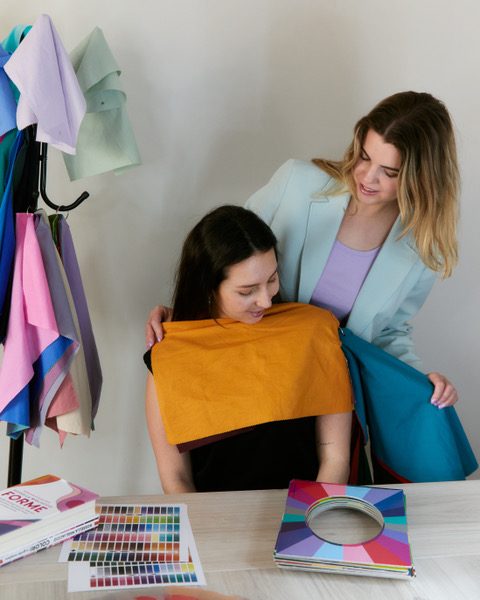
The seasons aren’t watertight compartments. A soft summer and a soft autumn share low intensity; a bright winter and a bright spring share vividness. That’s why, in the session, much of the work consists of comparing drapes from neighbouring seasons until it’s clear which way your face leans.
Armocromia and colour analysis: how do they differ?
In everyday use, they’re practically synonyms. “Colorimetría” is the more widespread word in Spain, and “armocromia” is the Italian term that has arrived strongly in recent years. Whichever you search for, a professional service should give you the same thing: an analysis with drapes, a personal palette and an explanation of how to use it. If you’d like to see the sessions I offer, you’ll find them in my services.
What an armocromia session is like
A session follows fairly fixed steps:
- Preparation: a make-up-free face, hair tied back or covered with a neutral cloth, and light as neutral as possible.
- Temperature test: warm drapes versus cool drapes, to see which even out the skin.
- Value, intensity and contrast: fine-tuned with light and dark, bright and soft drapes.
- Sub-group: neighbouring palettes are compared until yours is found.
- Practical application: how to combine the colours, which neutrals to use as a base, and which metals and make-up shades flatter you.
It can be done in person or by video call. In Madrid, while we open the studio, I do it online and in person on request; I explain it on the armocromia in Madrid page.
How it helps day to day
- Shopping better: you know in advance which colours to look for and avoid garments that end up forgotten.
- Combining with ease: if almost your whole wardrobe is within your palette, the pieces go together.
- Choosing make-up and accessories: lipstick and blusher shades, glasses frames or jewellery.
- Feeling more like yourself: the right colours draw attention to your face, not to your clothes.
The professional armocromia kit
For those who work in image consulting, working with drapes requires a complete, well-calibrated kit. That’s why I put together an armocromia kit designed for professionals in the sector. If what you want is to know your own palette, you don’t need the kit: a session is enough.
Frequently asked questions
Are armocromia and colour analysis the same thing?
They refer to the same idea: studying which colours harmonise with your skin, eyes and hair. “Armocromia” is the term that became popular in Italy and is now also used in Spain; “colorimetría” is the more common word here.
How many seasons and sub-groups are there?
Four seasons (spring, summer, autumn and winter), and each is divided into sub-groups. In Italian armocromia it’s common to work with four sub-groups per season, which gives sixteen palettes.
Do I need to buy a kit to have armocromia done?
No. The drape kit is a working tool for image professionals. If you want to know your palette, what you need is an analysis session; at the end you take away your own information and, in the in-person session, a pocket swatch.
Can armocromia be done online?
Yes, by video call, preparing the lighting and camera properly and following a few simple guidelines. The result is reliable if those conditions are taken care of.